



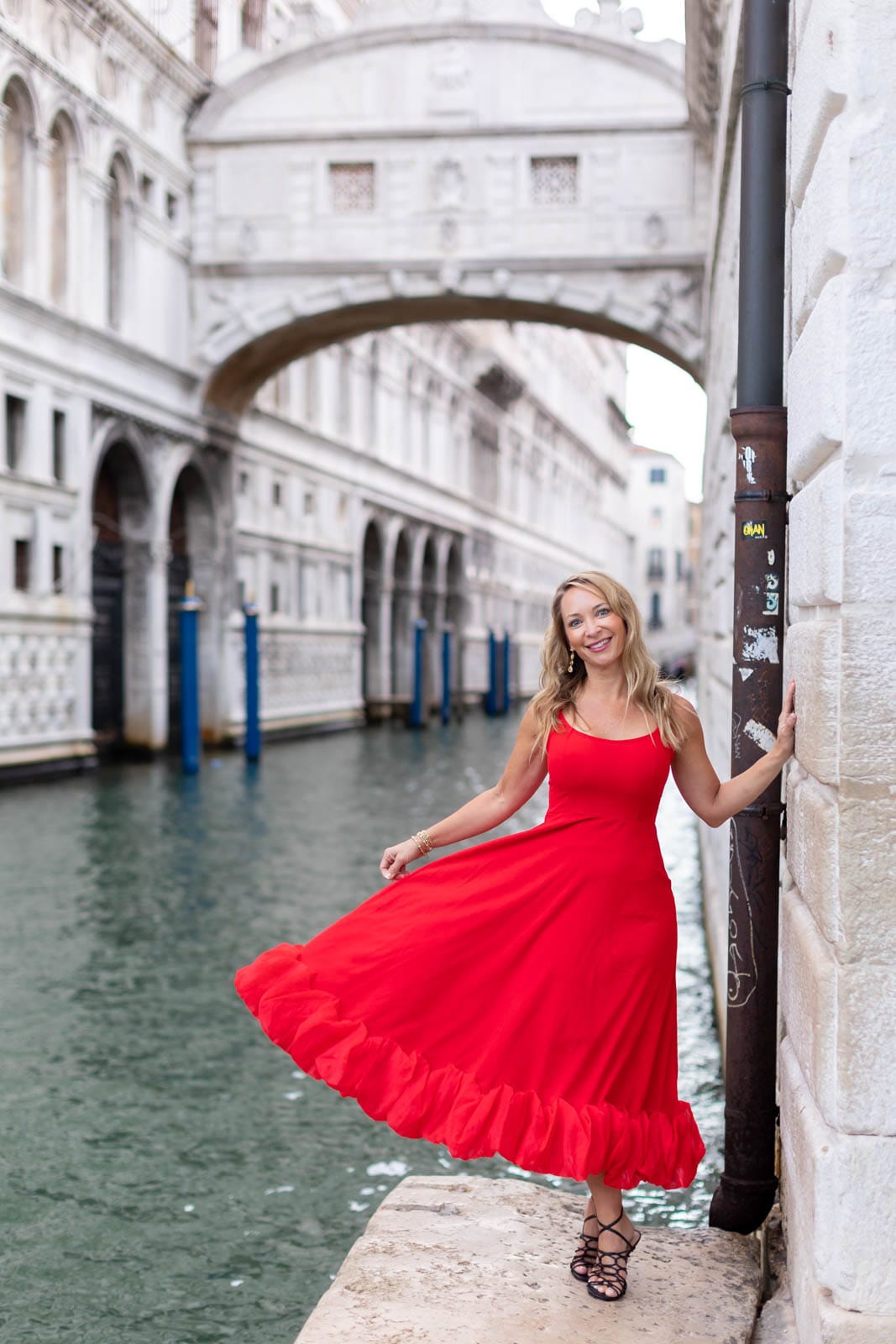
Wear what you’d wear to a good dinner: pastels if you want to blend into the city, a strong color if you want to stand out, and flat shoes in reserve. No shorts, no big logos, no busy patterns.
That’s the short version, and it’s about as far as most advice pages go. What follows is the part they leave out: where you change (there is nowhere), what a long dress actually costs you on the steps, how much of your session an outfit change eats, and what I’ve watched work in July and in November.
I’m Osvaldo. I live in Venice and I photograph here every week, so most of what’s below comes from watching the same things go right and wrong in front of my camera.
Can you wear heels for a Venice photoshoot?
Yes. I tell women to wear the heels they like — that part of the advice you read elsewhere is too cautious.
The condition is the backup. If the shoes are uncomfortable, or if you’re not used to walking in heels, bring a pair of flats as well. I can keep them in my backpack, so you’re not carrying a bag through the photos, and you swap when you’ve had enough.
That’s the whole system: heels for the frames you want in heels, flats for everything in between.
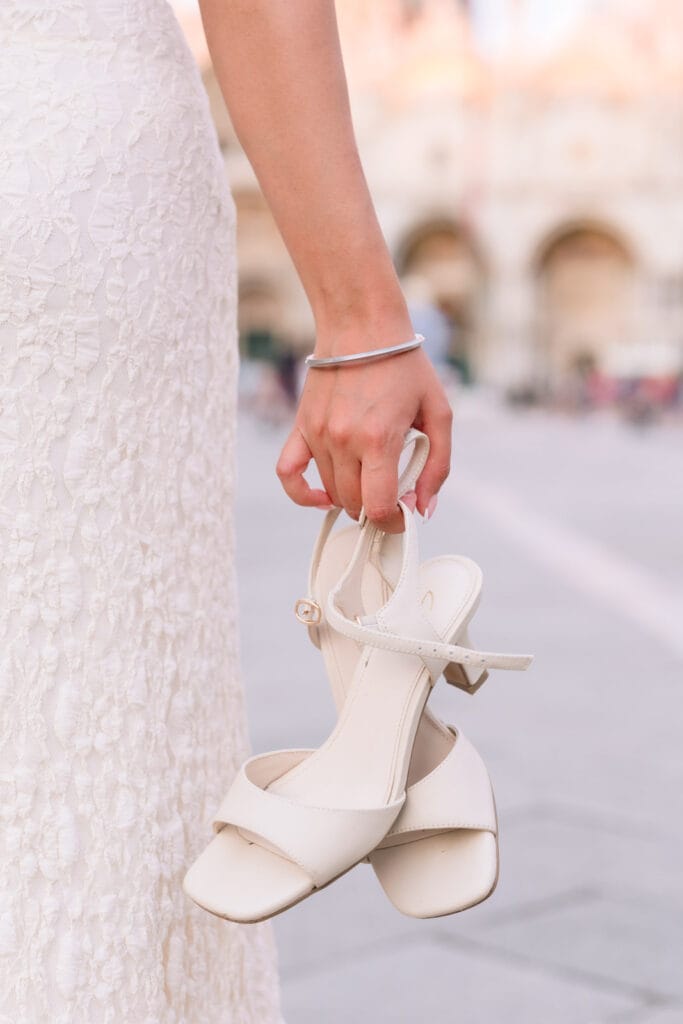
They live in my backpack all session, so nobody carries a bag through the photos.
Will a long dress get ruined on the bridges?
It can get a little dirty. That’s the honest answer, and it’s also the whole extent of the damage I’ve seen: dirty, not ruined.
My position is that it’s worth it. A long dress moves in a way nothing else does, and a hem that needs a brush at the end of the evening is a small price for the photographs you get from it.
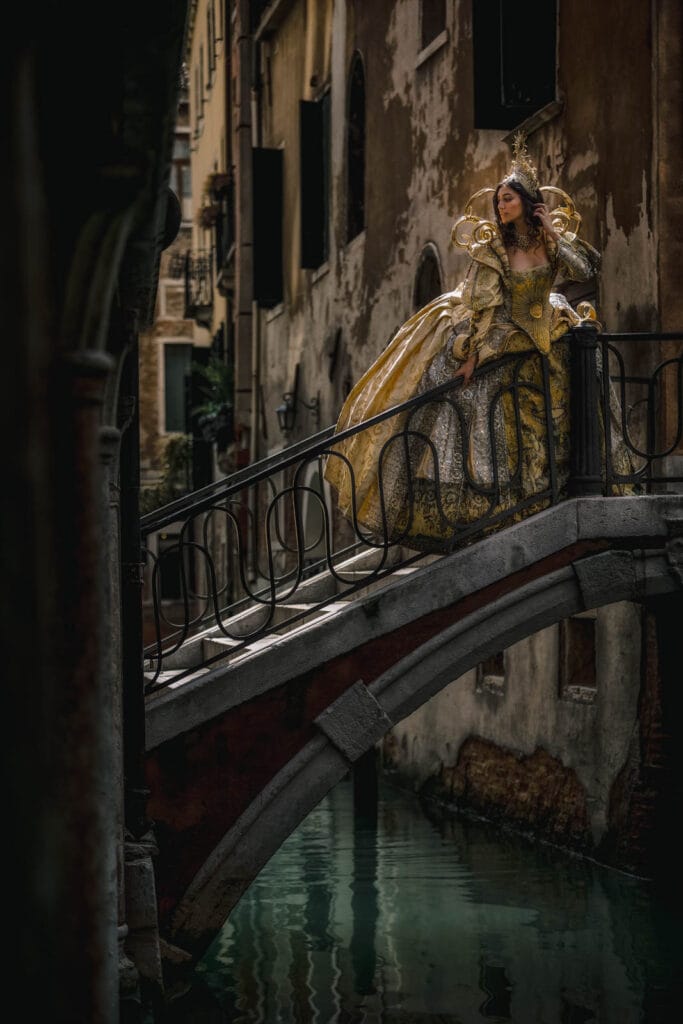
The hem picks up some dirt on the steps. In my experience that’s the whole cost.
The one case where I’d change the plan is a hem that actually touches the ground in winter — see acqua alta, below.
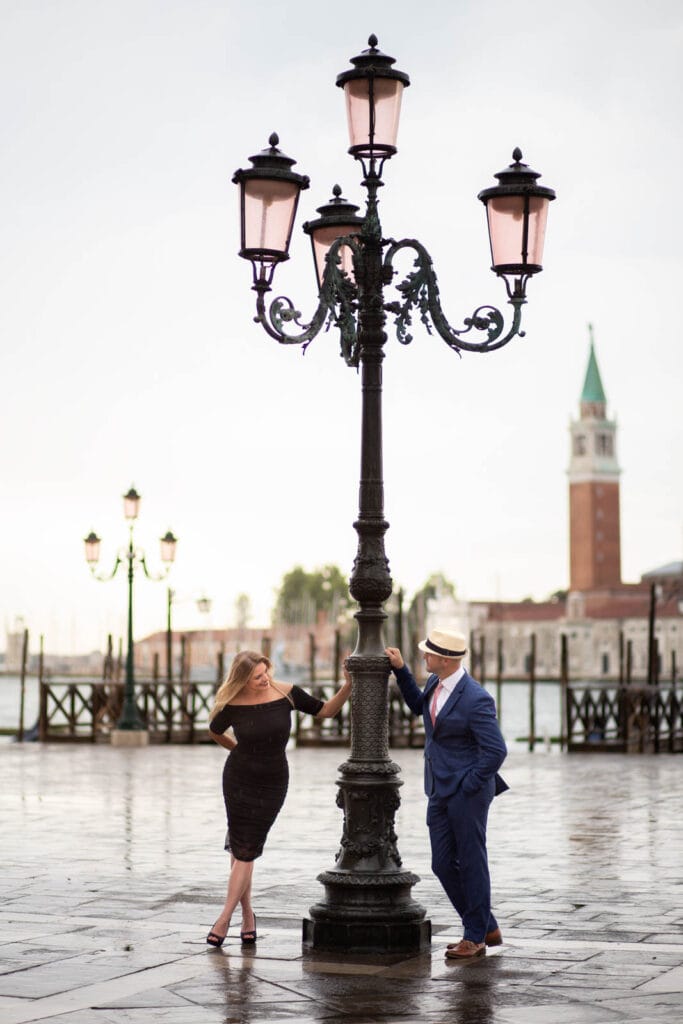
November light through the mist. This is the month I’d choose if I were the client.
Where do you change clothes during a photoshoot in Venice?
There is nowhere. This is the thing almost nobody tells clients before they arrive with a second outfit in a bag.
Two real options:
- Your hotel, if it’s near where we’re shooting. Cleanest solution by far.
- The bathroom of a bar. It’s a bit uncomfortable, but there is no alternative.
And it costs time. Between finding a place to change and actually changing, you lose 10–15 minutes on average. That’s why, when someone wants a second outfit, I recommend booking at least 90 minutes — an outfit change inside a one-hour session eats a quarter of it, and it’s the quarter with the best light in it.
So the practical decision is made before you pack: either your hotel is close and a change is easy, or you pick one outfit and we spend the time shooting.
Do you need to worry about acqua alta?
Almost certainly not.
High water happens rarely, usually only in winter, and it’s generally a few centimeters in a few parts of the city — not the flooded piazza you’ve seen in the news. If an exceptional tide is forecast, the MOSE barriers will be raised in about 90% of cases and there’s nothing to plan around.
Either way, we avoid it: I know which parts of a route stay dry, and we go there.
The only wardrobe consequence is the one I mentioned above — avoid a hem that drags on the ground if we’re shooting in winter. Everything else is unaffected.
Will the wind be a problem on a boat?
No, and this is the question I get most often from people picturing an open lagoon.
We spend most of the session in the inner canals, where it’s very calm. That’s where the boat actually goes, so a dress that would misbehave in open water simply doesn’t get the chance to. You don’t need to choose your outfit around the wind.
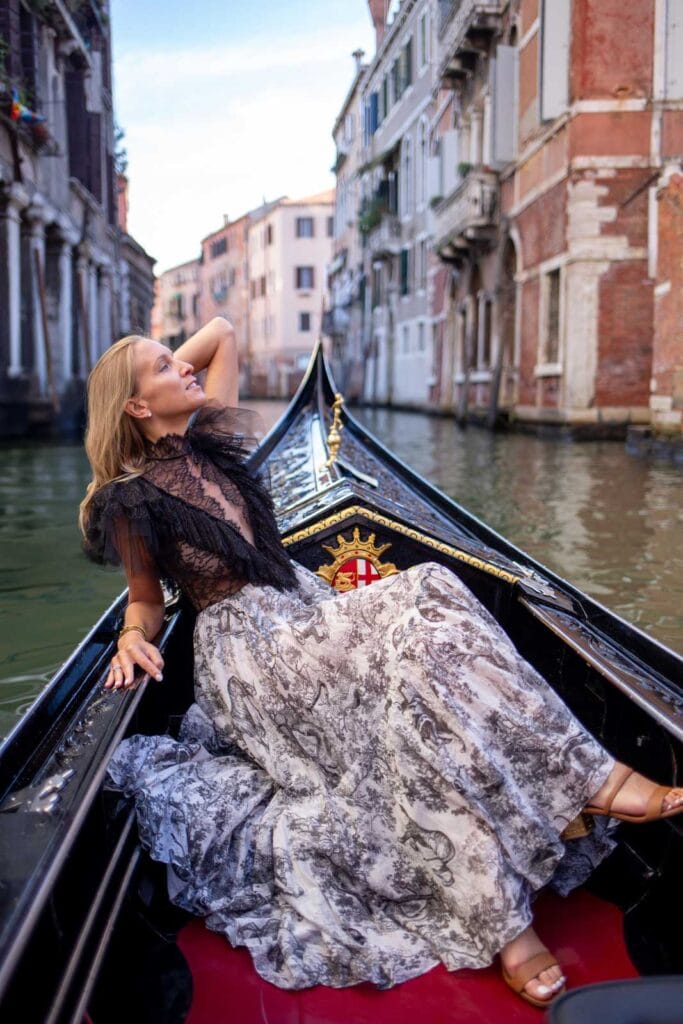
This is where most of a boat session happens. No wind to plan an outfit around.
Which colors actually work in Venice?
Two strategies, both valid. The choice is whether you want to blend into the city or stand against it.
Blend in: pastels. Beige, green, brick, light blue, pink. These mix well with the colors the city already has, so the person and the background belong to the same picture.
Stand out: strong colors. Bright colors read hard against Venice and have real impact. I love red — that’s a personal preference and I’ll say so, but it’s the one I reach for when someone asks me to choose.
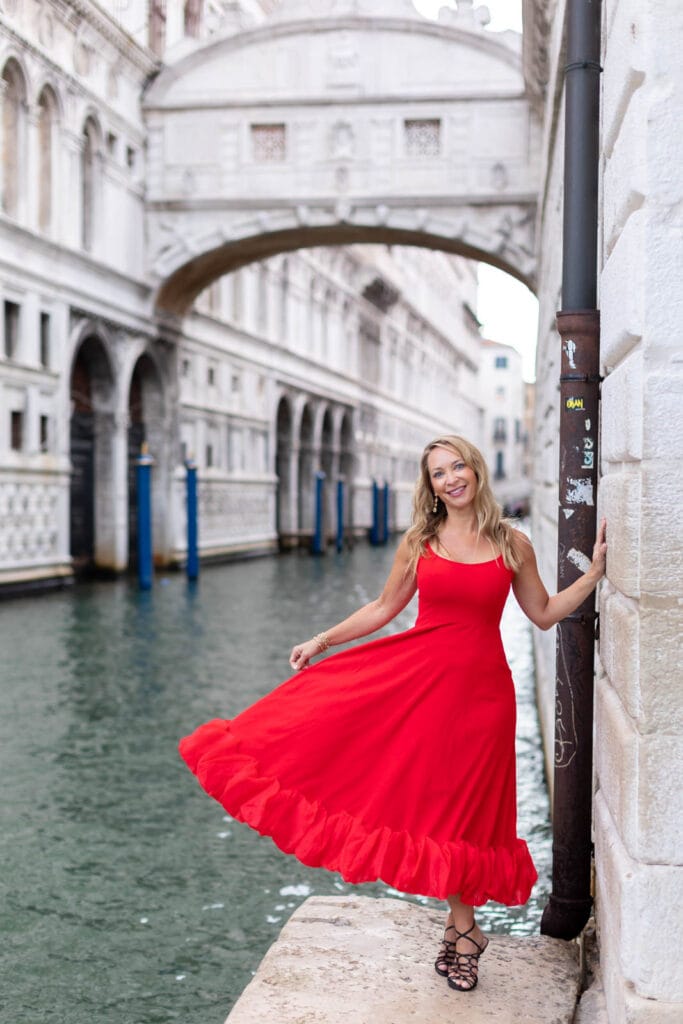
San Marco is the brightest background in the city — a strong color separates from it cleanly.
If you want neutral but not white: tan, blush pink, pale blue, navy, grey — they all read as neutral here. White itself is fine, with one warning: in the middle of a summer day the light is hard and white is the first thing to burn out. At sunrise or in the evening it behaves.
Where you’re standing changes the calculation:
| Area | What’s behind you | Consequence |
|---|---|---|
| San Marco | Very bright, pale marble | The background is light, so a strong color separates cleanly |
| Other areas | Brick dominates | Warmer, darker backdrop — pastels sit inside it rather than against it |
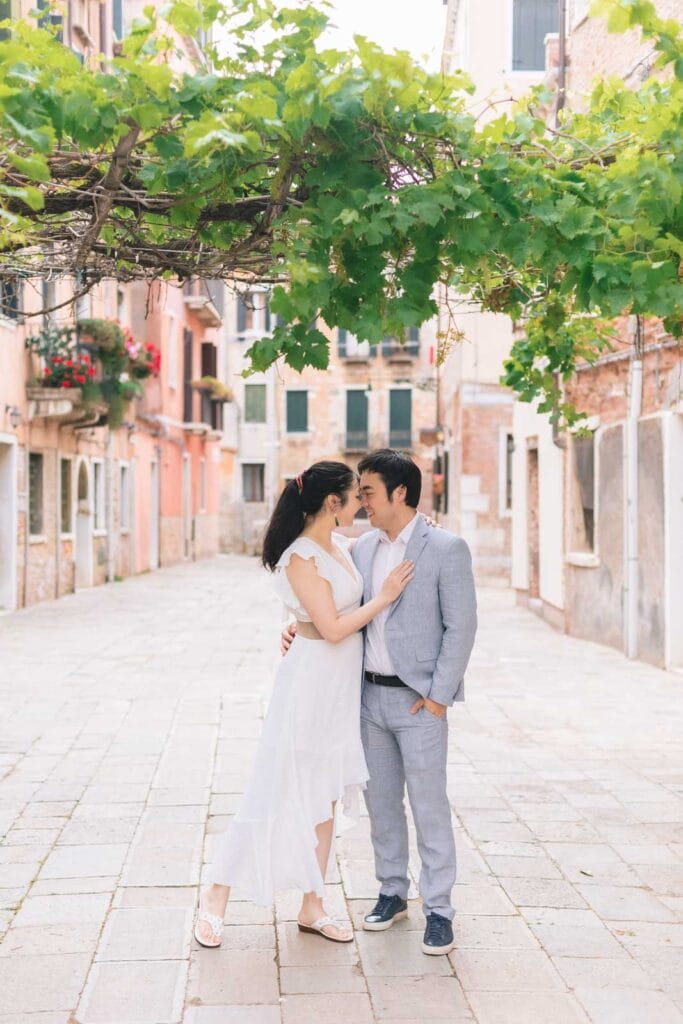
Same session, different street: pastels sit inside a brick backdrop instead of fighting it.
Three combinations I keep seeing work: champagne, ivory and soft grey with a single dark accent around San Marco — sage, stone and pale blue along the quieter canals — and, for a gondola, Venetian red with a partner in charcoal or cream.
Two things to leave at home, regardless of color: chaotic patterns and big brand logos. A busy print competes with a city that is already busy, and a logo dates the photograph to the season it was bought in.
What I tell people not to wear
Shorts. I know it’s hot in July. My advice is to suffer for an hour and have more elegant photographs — an hour of mild discomfort against pictures you’ll keep for years is not a close call.
More generally: avoid a sporty look. It’s the thing that most often makes a good session look like a snapshot.
What I suggest instead:
- Men: classic long trousers and a shirt.
- Women: a dress is the simplest choice. Trousers and a t-shirt work too, for a more casual look.
One more thing: dress like yourselves. If you never wear florals, a floral dress will read as a costume — and you’ll see it in your face in every photo. The best outfit is the elegant version of what you already are.
And what to add, instead: texture. A scarf, a hat, a belt, a soft layer — they give the frame depth, and they’re the easiest way to make a simple outfit look considered.
Two sessions where the clothes made the difference
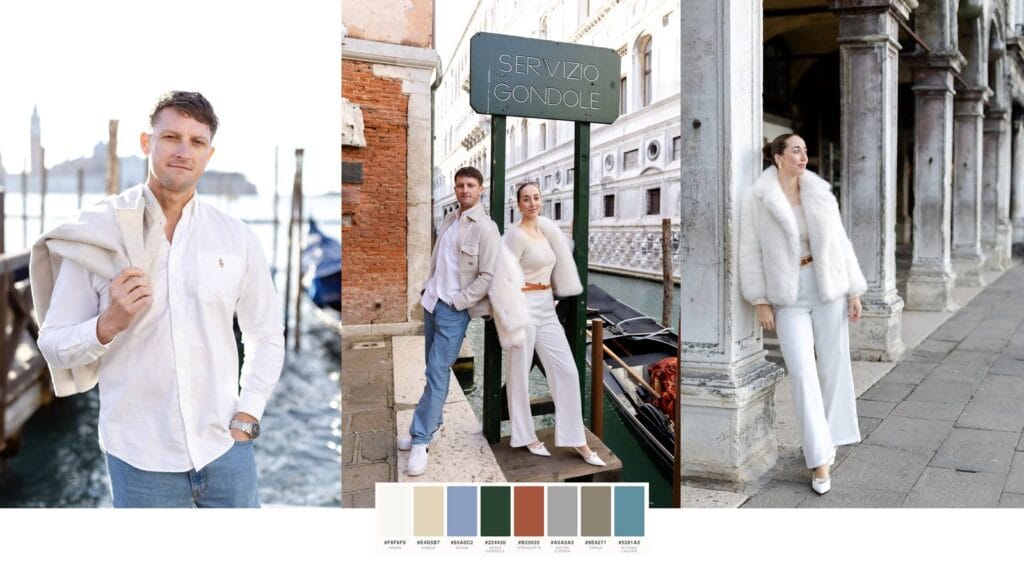
The idea, shown as a styling board: winter whites and heavy layers photograph warm — and nothing has to come off between shots.
The winter sweaters. A couple came to a winter session in thick, soft white knit sweaters instead of coats. The difference isn’t only how it reads — warm, close to Christmas — it’s practical: a coat has to come off for every shot and go back on between shots, and you spend the session dressing and undressing. They never had to.
The Gritti session. A session at the Hotel Gritti for a fashion influencer: a Moschino jacket, a Dolce & Gabbana bag — an outfit built entirely around statement pieces. Worn on a quiet back canal it would have tipped into costume; against the Gritti, the clothes and the location sat at the same level — and that is exactly why it worked.
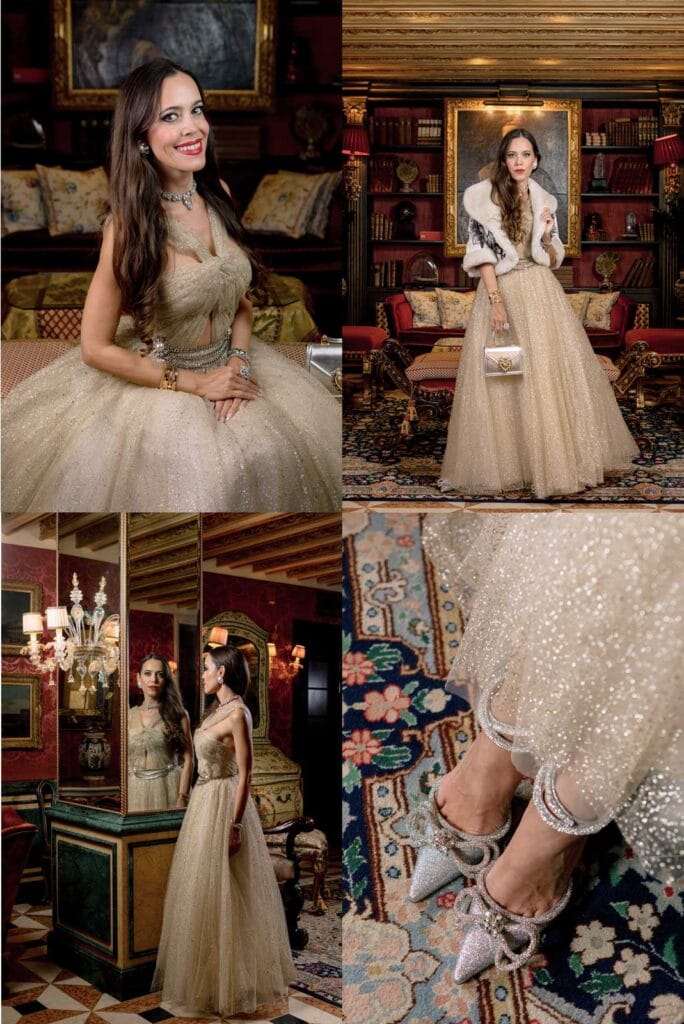
Statement pieces work when the location sits at the same level — here the Gritti does half the styling.
The practical rule I give families: pick four or five colors that sit well together, let one of them pop — a mustard, a red — and never dress everyone the same. Coordinated, not identical, works for six people exactly as it works for two.
What changes between July and November?
July. Hot and very busy. But sunrise is early, which means we can start when there’s nobody around and there’s already enough light. The other side of the same coin: sunset is late, which makes July ideal for a proposal followed by dinner to celebrate.
What to wear: light and cool — linen, flowing dresses, softer colors.
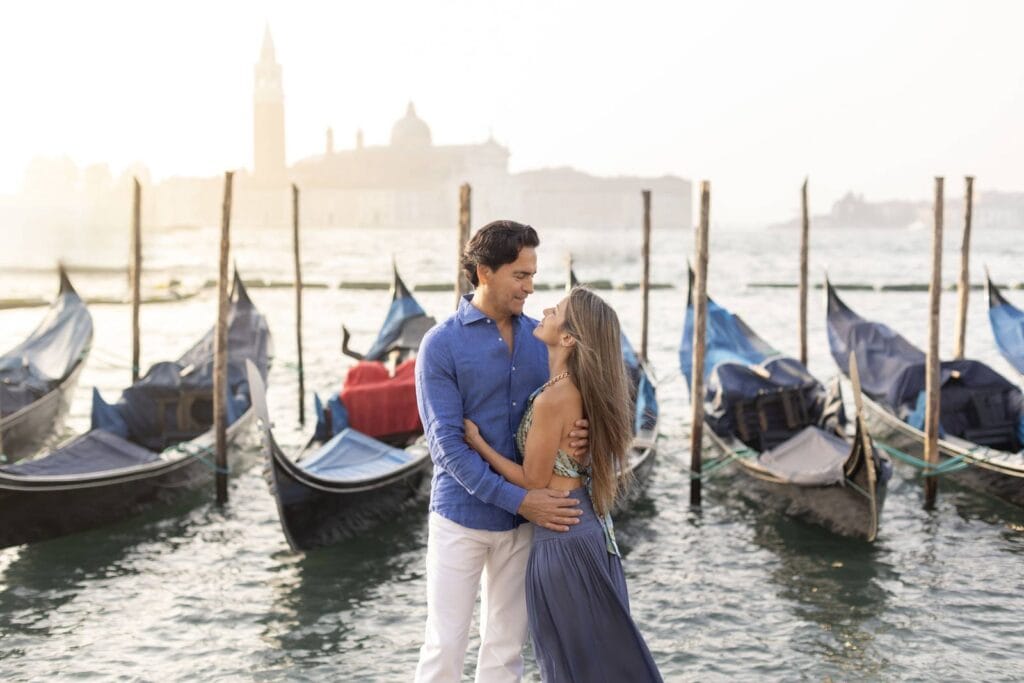
July sunrise: early enough that the street is empty, bright enough to shoot.
Late August. The Venice Film Festival takes over the Lido between late August and early September. It doesn’t change what you’d wear for a photoshoot in the city — but if you’re here for it and want to see the red carpet, I’ve written a guide on how that actually works.
November. The first half of the month is still mild; the end of it is cold. There’s less light, but there are also far fewer people, so we can start in the morning without a sunrise alarm — which suits anyone who doesn’t want to be awake at 5. And the winter light is the best of the year here: sometimes there’s a thin mist with the sun coming through it, and it gives the photographs a look you can’t get in summer.
What to wear: more structured and warm, with deeper or darker colors.
November light through the mist. This is the month I’d choose if I were the client.
Short answers
Can I wear heels?
Yes, the ones you like. Bring flats too — I’ll keep them in my backpack.
Is there anywhere to change during the session?
Your hotel if it’s close, otherwise a bar bathroom. There’s no third option.
How long should the session be if I want two outfits?
At least 90 minutes. The change costs 10–15 minutes on average.
Do we need to wear matching outfits?
No. Coordinated, not identical — matching is a dated look.
What about a coat in winter?
A coat comes off for every shot and goes back on in between. A heavy sweater doesn’t, and it photographs warmer.
Will it be windy on the boat?
No. Most of the session happens in the inner canals, and they’re very calm.
Are shorts really a problem in July?
Yes. One uncomfortable hour, much better photographs.
Should I worry about acqua alta?
No. It’s rare, usually winter only, a few centimeters in a few areas — and we avoid it. Just skip a hem that drags on the ground.
Patterns and logos?
Avoid busy patterns and large brand logos.
Can we wear black?
Yes. Give it texture — silk, satin, knit — so it doesn’t read flat, and it photographs beautifully against Venice.
Are jeans okay?
Dark wash, clean cut, something elegant on top — that combination works. Distressed denim doesn’t.
Anything worth packing?
A lint roller, spare hair ties, and a compact clear umbrella: if it rains, a clear umbrella looks wonderful in photographs.
If your session includes a gondola, the logistics are different and I cover them on the Venice gondola photoshoot page. Other practical questions — timing, delivery, rain — are answered on the Venice photographer FAQ.
When you know what you’re wearing, book your Venice photoshoot and tell me the outfit in the message: if it’s a long dress, or if you want a change of clothes, that changes the route and the length I’ll suggest.
— Osvaldo Di Pietrantonio, photographer in Venice


One Comment