


Last updated: October 2026 · Osvaldo Di Pietrantonio, photographer in Venice
Partly. In 2026 Venice charged day visitors €5 or €10 on 60 days, and paying day-trippers averaged 11,326 a day, about a third fewer than in 2024 (ANSA, July 2026). But the fee never capped how many people could come in (Il Post, April 2026), and the trial ended on July 26. Today you can walk in without paying, and nothing has been decided for 2027 (City of Venice, cda.ve.it).
What changed in 2026
- Nov 18, 2025: prices confirmed for 2026, €5 if you paid by the fourth day before your visit and €10 after (City of Venice, resolution 254/2025).
- Mar 5: exempt visitors get alternatives to the QR code, including a paper self-declaration (resolution 41/2026; exemptions page).
- Apr 3 – Jul 26: the fee applies on 60 days (54 in 2025, 29 in 2024), 8:30 am to 4 pm (City of Venice).
- Jul 29: provisional results, 679,553 paid vouchers and €5,215,035 collected (ANSA).
- Sep 27: Mayor Simone Venturini proposes up to about €30 on the busiest days; national law caps the fee at €10 (ANSA).
How much was the Venice entry fee in 2026, and when did you pay it?
The fee, officially the contributo di accesso (access fee), applied on 60 days between April 3 and July 26, 2026, from 8:30 am to 4 pm (City of Venice, March 2026), per person and with no reductions (City of Venice, access fee page). Outside those days and hours, entry was free.
The 2026 fee days
| Month | Days | Dates |
|---|---|---|
| April | 17 | 3–6, 10–12, 17–19, 24–30 |
| May | 15 | 1–3, 8–10, 15–17, 22–24, 29–31 |
| June | 16 | 1–7, 12–14, 19–21, 26–28 |
| July | 12 | 3–5, 10–12, 17–19, 24–26 |
Source: City of Venice, March 2026.
| When you paid | Price per person |
|---|---|
| By midnight on the fourth day before your visit | €5 |
| From the third day before your visit onward | €10 |
The city’s own example: for a Sunday, €5 if you paid by Wednesday, €10 from Thursday (City of Venice). Most people paid within three days of their visit: in 2026, 46.5% of paid vouchers were at €5 and 53.5% at €10 (ANSA, July 2026).
Where it applied. Only in the historic city. Lido, Murano, Burano, Torcello and the other minor islands were excluded in 2026 (City of Venice, access fee page; list of islands in the regulation, annex 2), and so were arrival areas such as Piazzale Roma, Santa Lucia station and Tronchetto, as long as you stayed there (City of Venice).
How you paid. On the official portal, cda.ve.it, by card or PayPal; the QR code was your ticket, and you had to carry it (City of Venice, March 2026). There were no turnstiles (City of Venice): stewards checked QR codes at gates on the main routes into the city, with priority lanes for residents and workers, and inspectors ran spot checks beyond them. More than 150 stewards, inspectors and police officers were on duty on the first day (City of Venice, April 2026).
The fine. The current regulation sets it at €25 to €150, plus the €10 fee (City of Venice, regulation updated December 2025). Some articles still give €50–300 (Il Post, 2024); I’m going by the regulation’s current text. Local police wrote 2,642 reports in 2026; the city hasn’t said how many became fines (VeneziaToday, July 2026).
Who was exempt from the Venice access fee?
If you stayed overnight in a hotel or rental anywhere in the municipality of Venice, you didn’t pay: the fee is the day visitor’s alternative to the tourist tax. You still needed an exemption QR code or, new in 2026, a paper self-declaration (City of Venice, exemptions). These are the main exempt groups (City of Venice, regulation).
| Exempt, nothing to register (show a document) | Exempt, registration needed (QR code or paper form) |
|---|---|
| Residents of the City of Venice, and people born there | Overnight guests who pay the tourist tax, from arrival to departure day |
| Residents of the Veneto region | Workers, including commuters |
| Children under 14 | Owners paying property tax (IMU) in Venice, and their families |
| Students, including commuters, of schools and universities in the historic city or the islands (institute badge or letter) | Relatives of residents up to the third degree, and people visiting residents |
| European Disability Card holders, plus a companion | Medical visits, funerals, court hearings, school trips |
Source: City of Venice, exemptions page, read October 2026.
Did the fee reduce the crowds? The numbers
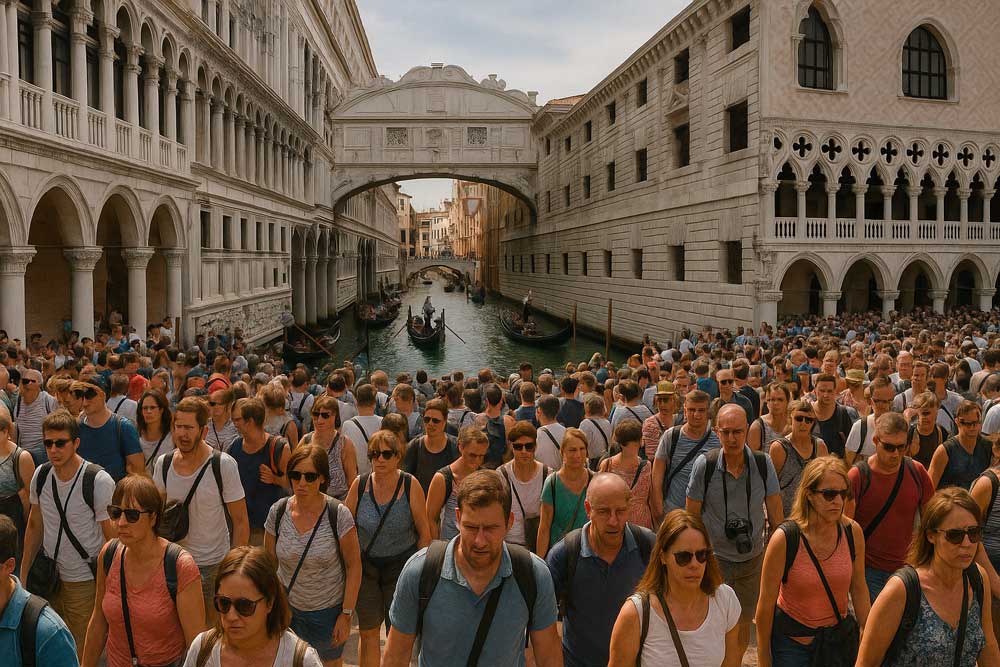
On the city’s own figures, paying day-trippers fell every year: about 16,700 a day on average in 2024, 13,398 in 2025 and 11,326 in 2026 (City of Venice, 2025; VeneziaToday on the city’s note, July 2026; ANSA, July 2026).
Averages are paid vouchers divided by fee days: 485,062 ÷ 29, 723,497 ÷ 54, 679,553 ÷ 60. The city’s August 2025 release prints 16,676 for 2024 and 13,046 for 2025 (portal sales only); its July 2026 comparison uses 13,398 for 2025 and a 32.3% drop on 2024, which matches 16,726. Sources: City of Venice, August 2025; VeneziaToday, July 2026; ANSA, July 2026.
The peaks fell further. Days with 20,000 or more paid vouchers: 4 of 29 in 2024, 3 of 54 in 2025 and one of 60 in 2026, Saturday May 2, with 25,471 (ANSA, July 2026).
Revenue: about €2.4 million in 2024 and €5,421,425 in 2025 (City of Venice, 2025), then a provisional €5,215,035 in 2026 (ANSA, July 2026), of which €1,771,000 goes toward cutting residents’ waste tax (VeneziaToday, on the city’s note, July 2026).
What these numbers don’t show
- They count paying day visitors only. In 2025 an average of 36,639 overnight guests a day registered as exempt, against 13,046 paying day-trippers (portal sales) (City of Venice, 2025).
- The years aren’t directly comparable, as VeneziaToday noted when it published the city’s figures: 2024 had no Fridays, and 2026 had six extra weekdays. The 2026 figures are still provisional (VeneziaToday, July 2026).
- UNESCO’s World Heritage Committee declined to put Venice on its “in danger” list in 2023 and again in July 2025, citing among other things the ban on big ships and the access fee (Italian Ministry of Culture, 2023; Foreign Ministry, 2025). The draft decision prepared for its July 2026 session called the fee “not yet fully effective” at reducing visitor numbers and asked for a carrying-capacity study (Il Gazzettino, July 2026).
Will Venice charge an entry fee in 2027?
Nothing has been decided. As of October 12, 2026 there is no calendar or price for 2027; the official portal says that is up to the city’s governing bodies (cda.ve.it; City of Venice, regulations page). What has been said so far (my translations):
- Mayor Simone Venturini wants a ceiling of “around 30 euros”, only on the busiest days, alongside the €5 and €10 rates: “For the moment we can’t go above 10 euros, but we have raised the question in Rome” (ANSA, September 2026). In June he had spoken of €50 (Il Gazzettino, June 2026).
- Michele Zuin, who runs the city budget, expects “an increasingly stable structure” from 2027 and says a longer season, possibly with March and September, is under consideration, but “we haven’t decided yet” (Il Gazzettino, September 2026).
- Gianmarco Mazzi, Italy’s tourism minister: “We are against creating taxes, even if they fall on tourists” (VeneziaToday, September 2026).
The €10 cap is national law, which ties the fee to the maximum tourist tax (City of Venice, resolution 41/2026). In September the two councillors in charge said it was “still too early” to say how the fee will be structured in 2027: the city will review the trial by the end of the year, “as always”, and only then set and announce “the new dates and rates” (Il Gazzettino, September 2026). Planning a day trip next spring? Check cda.ve.it before you go.
How many tourists come to Venice, and how many residents are left?
Overnight tourism in the municipality passed its pre-pandemic peak in 2024 and eased slightly in 2025: 9.42 million nights in 2011, 12.95 million in 2019, 3.56 million in 2020, 12.63 million in 2023, 13.29 million in 2024 and 12.93 million in 2025, from 5,858,665 arrivals. Of the 2025 nights, 9,376,638 were in the historic city, where the average stay was 2.36 nights (City of Venice, Tourism Yearbooks 2023, 2024 and 2025, on Veneto Region statistics).
Millions of nights, whole municipality. Sources: City of Venice, Tourism Yearbooks 2023, 2024 and 2025, on Veneto Region statistics.
ISTAT’s national report gives the same 2024 figure and ranks Venice third in Italy for overnight stays, after Rome and Milan (ISTAT, March 2026).
The historic center keeps losing residents: 174,808 in 1951, 108,426 in 1971, 58,991 in 2011, 49,172 at the end of 2023 and 48,489 at the end of 2024 (Metropolitan City of Venice; City statistics, via We Are Here Venice; Il Post, 2025). A civic counter, not an official one, read 47,652 in May 2026 (Il Post, May 2026).
Sources: Metropolitan City of Venice, DUP 2025–2027 (1951, 2023); City of Venice statistics office, reproduced by We Are Here Venice (1971, 2011); City statistics office via Il Post (2024).
At the end of 2025 the historic center had 70,241 tourist beds, 49,345 of them outside hotels (City of Venice, Tourism Yearbook 2025), against 48,489 residents at the end of 2024, the latest official count (Il Post, 2025): more beds for visitors than people living there, and the gap is widening, from 60,638 beds in 2023 to 65,534 in 2024.
What else has Venice done against overtourism?
- Big cruise ships out of St Mark’s. Since August 1, 2021, ships over 25,000 gross tons, longer than 180 meters or taller than 35 meters above the waterline can’t sail through St Mark’s Basin and Canal or the Giudecca Canal (Decree-Law 103/2021). In 2026 cruise ships berth at Fusina, Marghera and San Basilio; only ships up to 25,000 tons use the Marittima (Shipping Italy, March 2026).
- Tour groups of 25 at most, and no loudspeakers, since August 1, 2024, in the historic center, Murano, Burano and Torcello (City of Venice). By June 13, 2026 police had fined 46 guides, about €50,000 in total (Il Gazzettino, June 2026).
- Tourist tax. €1 to €5 per person per night in historic-center hotels, for up to five nights (City of Venice). A rise to €3–9 was put to trade associations in September 2026 and has not been approved (Il Gazzettino, September 2026).
- Short-term rentals. A rule requiring registration to rent a home to tourists for more than 120 days a year was adopted by the city executive in October 2024 (City of Venice) and has not been passed by the city council (Il Gazzettino, August 2026).
- Behavior fines. Eating while sitting on the ground, or sitting on bridges, quays and monuments: €100–200 and a ban from the area. Swimming in the canals: €350. Riding, or even pushing, a bike: €100 (City of Venice).
- Guardians. Eleven stewards and a supervisor in St Mark’s and around Rialto, 10 am to 6 pm, until November 1, 2026 (City of Venice, April 2026).
- No cap on numbers. The mayor calls a closed number “a measure we cannot apply” (Il Gazzettino, June 2026).
Where and when is Venice still quiet?
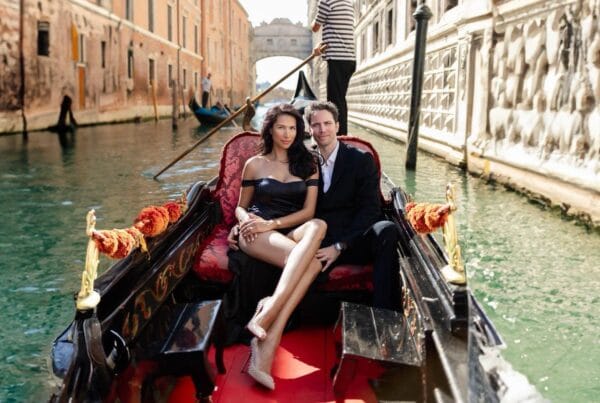
This part comes from my work, not from reports. I’ve photographed people in Venice since 2013, with more than 500 gondola sessions, and I plan every shoot around these crowds.
- Mornings first. I always suggest the morning and take the famous places at sunrise or in the first hour. With families, St Mark’s Square means starting between 7:30 and 8:00 am, while it’s still empty.
- After 9 am, away from the landmarks. I move to quieter areas, starting from my clients’ hotel. The fee hours, 8:30 am to 4 pm, fall almost entirely inside the part of the day I keep people away from St Mark’s.
- Late afternoon, out of the center. By then the center is packed, so I meet clients in Campo San Vio, in Dorsoduro, and we finish with a gondola at sunset.
- At sunset, San Giorgio Maggiore. I prefer it to St Mark’s for the setting and the light; it’s three minutes by waterbus from San Marco.
- In winter fog, the opposite. St Mark’s in the morning: from San Giorgio the skyline disappears.
- Weekdays, if you can choose. The busiest fee day of 2026 was a Saturday (25,471 paid vouchers), the lightest was Wednesday, April 29 (7,441), and Saturdays averaged 13,661 (ANSA, July 2026). Daily averages also fell through the season: about 13,940 in May, 10,179 in June and 9,597 in July (VeneziaToday, July 2026).
- Quieter neighborhoods. Cannaregio, Castello and the Giudecca are mostly residential and see fewer visitors than San Marco and San Polo (The Local, 2023).
Quick answers about the Venice entry fee
Do I have to pay to enter Venice right now?
No. The 2026 trial ended on July 26; since July 27 there is nothing to pay and no exemption to request (cda.ve.it).
Do hotel guests pay the Venice entry fee?
No. In 2026 overnight guests were exempt, but had to register for a QR code or fill in the paper form (City of Venice).
Is there an entry fee for Murano and Burano?
Not in 2026: the minor islands, Lido included, were outside the fee area (City of Venice, access fee page; list of islands in the regulation, annex 2).
Sources
Official
- City of Venice, access fee portal: cda.ve.it · Access fee · Exemptions · Myths to dispel (read October 12, 2026)
- City of Venice, press releases: 2026 calendar and portal opening (March 2026) · first day of 2026 (April 3, 2026) · the 2025 numbers (August 4, 2025) · Guardians (April 2026) · short-term rental rule
- City of Venice: access fee regulation, updated to DCC 57/2025 (PDF) · resolution 254/2025 (PDF) · resolution 41/2026 (PDF) · regulations and resolutions
- City of Venice, Tourism Yearbooks: 2023 data · 2024 data · 2025 data (PDF)
- City of Venice: tour groups · behavior fines · tourist tax rates from April 1, 2025 (PDF)
- Metropolitan City of Venice, DUP 2025–2027 (PDF)
- ISTAT, Tourist flows, 2024 (March 2026, PDF)
- Normattiva, Decree-Law 103/2021
- Italian Ministry of Culture, UNESCO decision on Venice (September 2023)
- Italian Ministry of Foreign Affairs, joint note on Venice and its Lagoon (July 2025) · UNESCO World Heritage Committee, Decision 47 COM 7B.113 (July 2025)
Press
- ANSA: 2026 results (July 29, 2026) · Venturini on a €30 fee (September 27, 2026)
- Il Gazzettino: fines for tour guides (June 2026) · the €50 request (June 2026) · interview with the mayor (June 2026) · UNESCO draft (July 2026) · short-term rentals (August 2026) · tourist tax proposal (September 2026) · timing of the 2027 decision (September 2026) · Zuin on 2027 (September 2026)
- VeneziaToday: 2026 data (July 29, 2026) · Minister Mazzi (September 2026)
- Il Post: first fee day (April 2024) · residents (September 2025) · the 2026 fee (April 2026) · depopulation (May 2026)
- The Local Italy, escaping the crowds in Venice (September 2023)
Other
- Shipping Italy, 2026 cruise season (March 2026)
- We Are Here Venice, population report reproducing City of Venice statistics (October 2019, PDF)